One of the botrylloides we found at St Helens was growing on the exterior of a different type of sea squirt. The sea squirt was already damaged, so team ascidian decided to take advantage of the opportunity and let me get a closer look at the internal organs.
I’d never seen this before. I’m lucky if I see anything other than the siphon. It shows just how much is unknown – and how much there is beyond a species external characteristics.
I had to ask for more clarification about the features when I got home. I’ve summarized my learnings as best as I could. Any errors are mine.

The part that stands out in this species is the siphons. They are the red bits at the very top of the image. Solitary ascidians have two siphons: the branchial and the atrial siphon. The atrial siphon is where the gut loop ends. It is often smaller than the branchial, but not always.
The branchial siphon can also be called the incurrent oral siphon. Basically, one siphon is for food to go in – the other is for it to go out. You could argue it’s similar to a human torso – but that analogy only goes so far. And can lead to puns about air coming out of both ends.
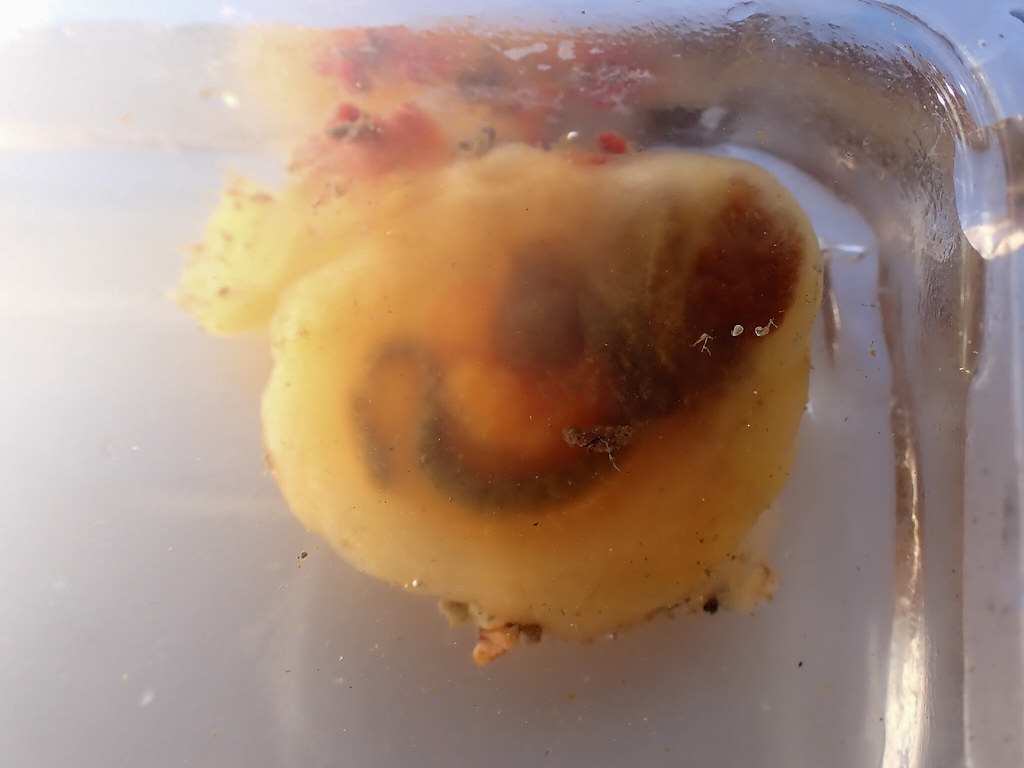
You can also see some of the insides/organs.
The one that is closest to the bottom left is the gut loop.
In the curve of the gut loop are three pink/orange gonads. This means that it is possibly a Microcosmus species, as Pyura have the gonads inside of the actual gut loop. I’m going to need to see more images of this for it to make sense.
The gut loop is pale in the bit before it bends because it’s carrying food collected in the branchial sac. The food changes colour as it is digested and eventually becomes brown faeces.
We can’t be 100% sure of the other organs as the sea squirt was injured.


